Challenges and joys of stocking Lake Leota
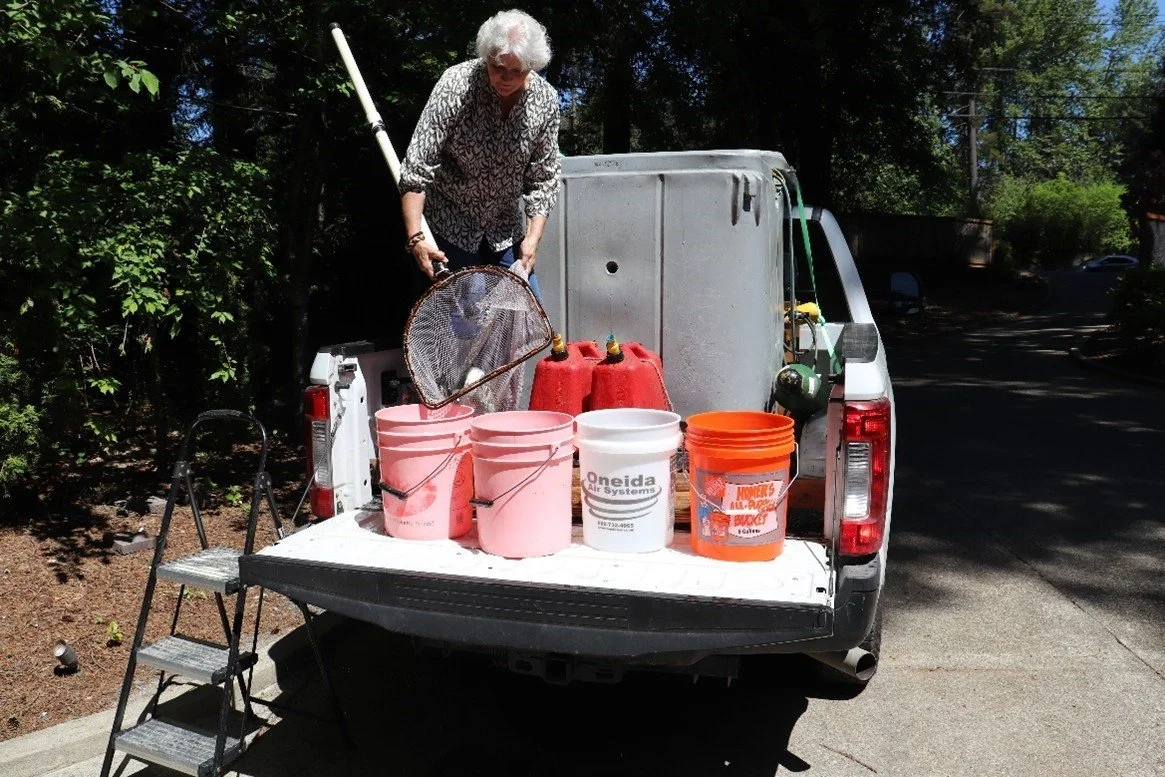
A low breeze passed through the trees and over the lake's water. Residents, some with their children, turn from their conversations as a white Ford F-250 laden with fish backs down the driveway. An older woman named, Diana, with curly short white hair steps out and introduces herself. Diana then pulls herself up onto the bed of the truck, opens a massive grey plastic tub, dons two camo gloves and starts unloading fish into several five-gallon buckets for the children and their parents to release into the lake.
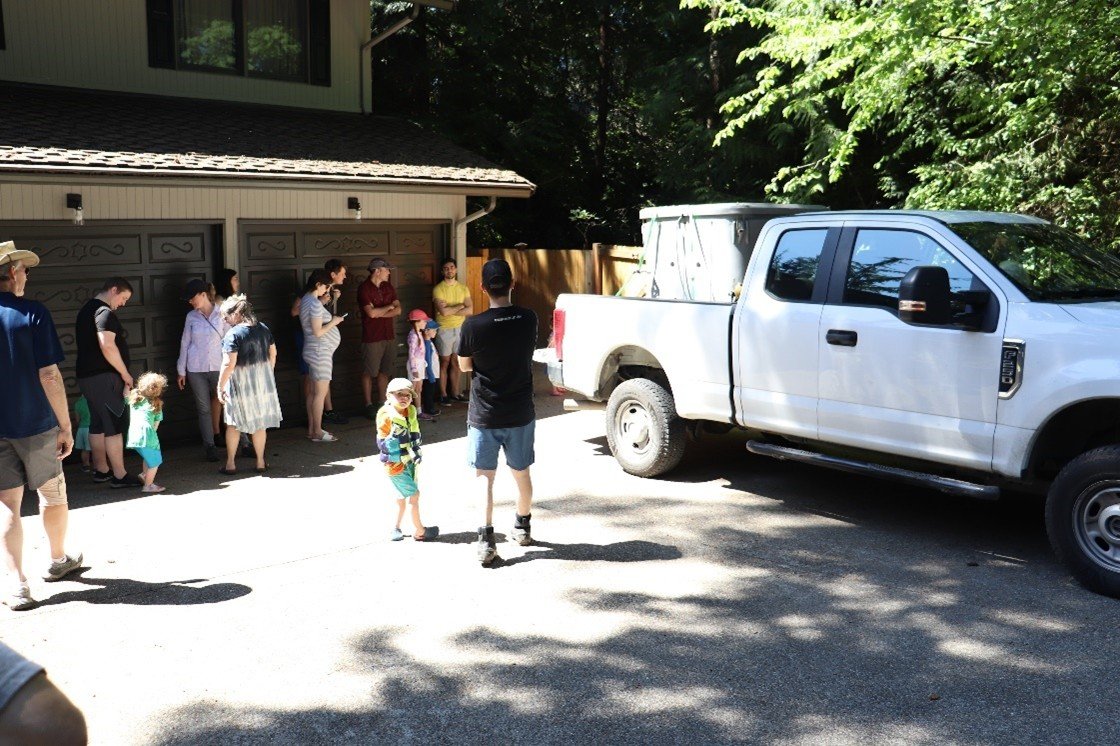
Families and residents gather around a white pickup truck with a massive grey tub in the bed, waiting for fish to be deposited
into buckets to be carried to the lake.
It’s Saturday, May 11th, 2024, on Lake Leota, an about 5-minute drive east of Woodinville Washington. The lake is being stocked, that is, fish that have been artificially raised in a hatchery are being released in the lake. This is quite a common practice, according to the Washington Department of Fish and Wildlife, over 500 water bodies are stocked with trout and kokanee every year by the agency.
Lake Leota is not stocked by the state, however. According to Janet Brady, a resident at the lake for over 15 years, “at one point the county actually stocked it… but because there is no public access they stopped.” The responsibility of organizing funding falls instead to the Lake Leota Community Club.
Created in the 60s, the club now deals with environmental efforts, community issues and organizes events around the lake. Part of these efforts is collecting funding from residents for various efforts to revitalize and maintain the lake.
A recent effort, organized by then new club president Bridget Huttenlocher saw invasive water lilies sprayed with herbicides. Huttenlocher is often concerned with environmentalism, so this was not her first attempt. Previously a more environmentally friendly attempt organized by her, made up of volunteers from around the lake to manually pull the weeds, failed after three months of work. The lilies came back.
The lake is often stocked yearly but last year the club failed to raise enough funds to do so. Huttenlocher, who helped organize this month’s lake stocking as well with fellow resident Naga explained why, “I think part when we have a mix of people that rely on snail mail for messaging and those that rely on electronics and so I think, you know, we are a very small board, and we just don’t have the manpower to send out a lot of snail mail communications. It’s much easier and faster to send an email. So, I think we might have missed a couple people in the past doing that.”
Fortunately, they were able to raise enough funds this year. Though Huttenlocher and Naga didn’t just order the fish; they also wanted to make sure it wasn’t bad for the environment.
Huttenlocher contacted the Department of Fish and Wildlife to find out more about the environmental concerns of stocking a lake. From what Huttenlocher learned, “a general guideline is 20-30 fish per surface acre. Lake Leota is a 10-surface acre lake so we would generally want to stock 200-300 fish.”
They planned to stock the lake with Rainbow Trout which was what the lake had been stocked with historically, but they didn’t want to stock the lake with an invasive species. The lake already has bass which Huttenlocher said, “…are invasive and will eat anything.” Thankfully, her contact at the Department of Fish and Wildlife said that Rainbow Trout have been around so long they are no longer considered invasive and are fine to put in Washington lakes.
With the money they had, about $1200, they purchased 258lbs of Rainbow Trout which is equivalent to roughly 250 fish. All that was left was actually stocking the lake.
Diana from J&D Fisheries in Darrington loads fish from her grey
tub into 5-gallon buckets in the bed of her pickup truck.
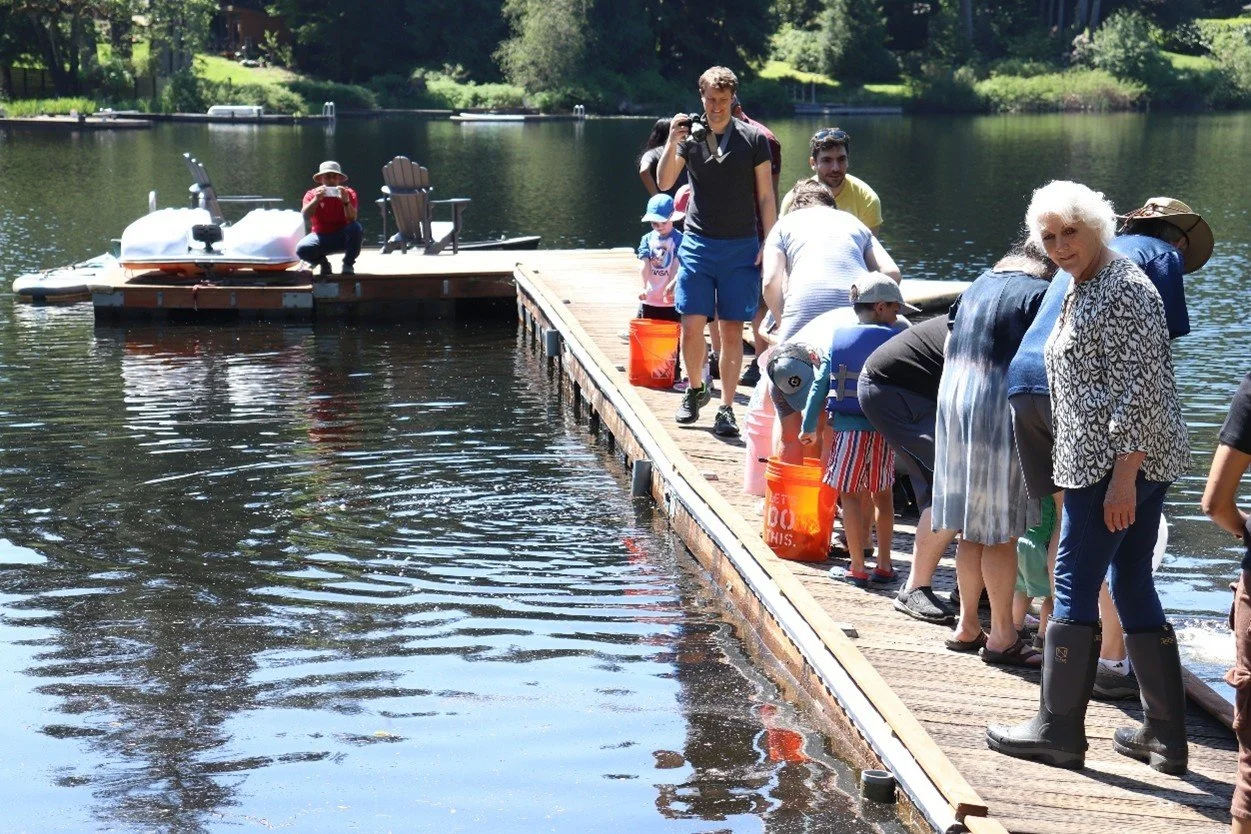
Diana stands on a long dock watching the parents and
the children that surround her toss fish into the lake.
Once the buckets were full of fish, adults hauled them from the driveway of Naga’s house to lake in the back yard. Children followed them peering into the buckets; jumping away when a fish thrashed, kicking up water into their faces. They walked out onto the dock, careful not to unbalance it with so many people on it.
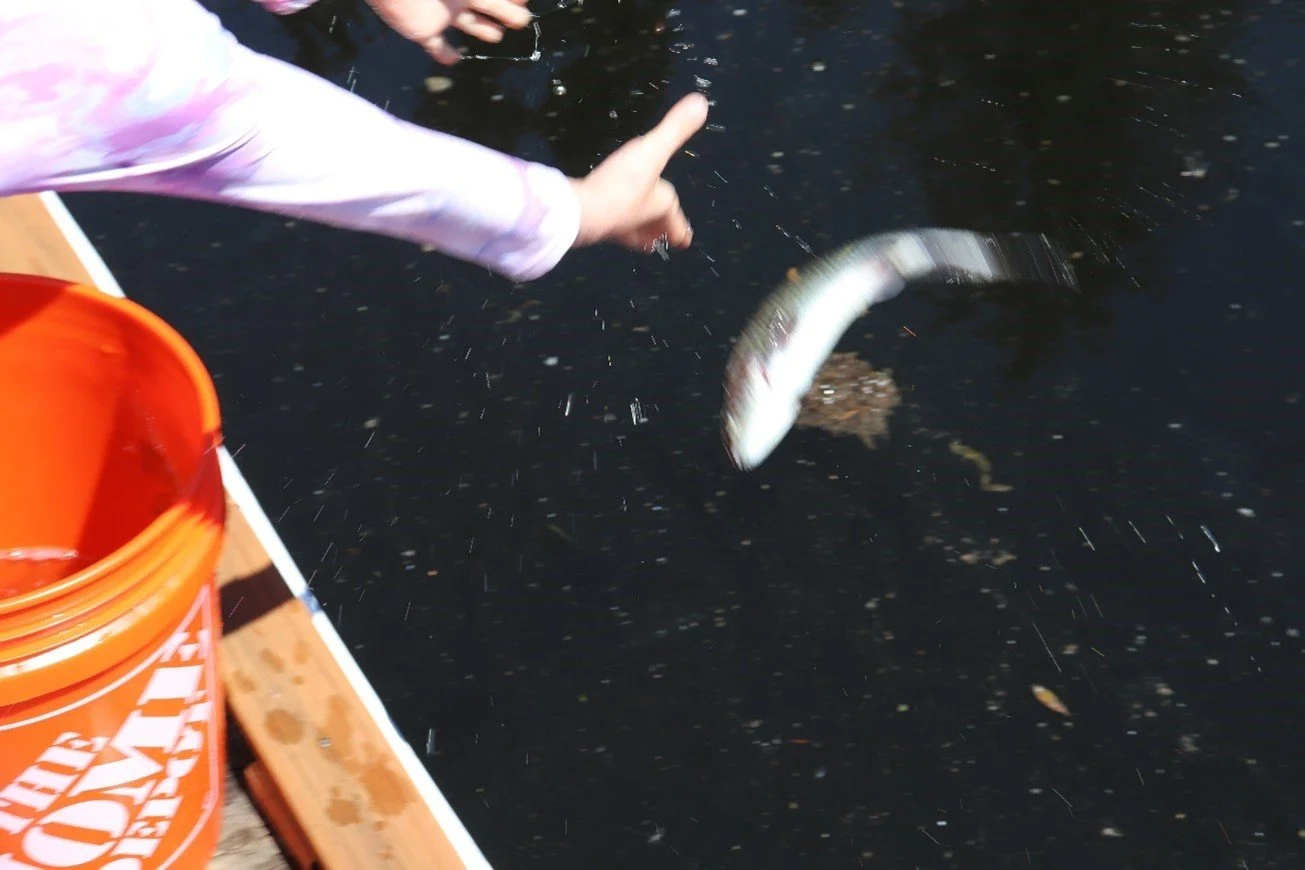
Parents watched as their children reached in with wonder. The children struggled to hold onto the slick fish as they were pulled from the bucket and tossed into the water. The fish quickly swam away, disappearing into dark shadows and behind underwater plants.
The day was overall a success. The families created memories. People caught up with each other. And everyone had fun. And this is just the beginning.
Brady looks forward to seeing the activity the restocked lake will foster, “we don’t fish… but we look forward to the osprey and the eagle, the river otters when they show up, and for the little kids. I like to see them out rowing around with their lines in the water.”
A child in a pink shirt tosses a rainbow trout. The image shows the fish moments before it hits the water. An orange Home Depot bucket sits nearby holding more fish.